
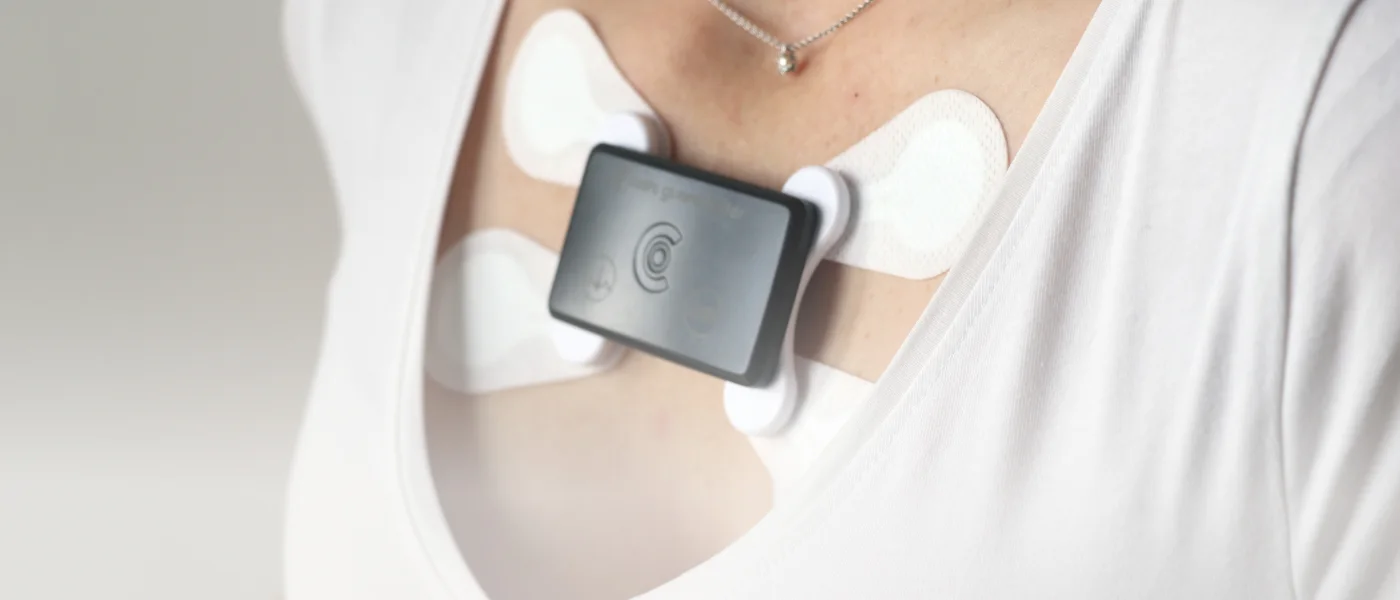
What is a long-term ECG?
A long-term ECG records your heartbeat continuously over several days, including at night and during all your everyday activities.
- Conventional: a recorder worn on a belt, connected by cables to electrodes on the chest, usually for 24 hours.
- At our practice: a small, lightweight device without cables, worn directly on the chest. You will hardly notice it in daily life.
- Up to 10 days: This also captures arrhythmias that occur only every few days.
A 7-day ECG detected atrial fibrillation more than twice as often as a 24-hour ECG.
- 7 days instead of 24 hours: 224 patients wore a long-term ECG for 7 days immediately after a stroke or a transient ischaemic attack (a brief disruption of blood flow to the brain). Previously unknown atrial fibrillation was found in 12.5%.
- The longer, the more: When only 24 hours of the recording were analysed, the figure was 4.8% on average, and 6.4% after 48 hours. Each additional day added further findings.
- Consequences for treatment: 15 of those affected, or 6.7% of everyone examined, had been discharged without anticoagulant medication after the standard work-up with a 24-hour ECG. In atrial fibrillation, these medicines significantly lower the risk of stroke.
Source: Stahrenberg R et al. Stroke 2010;41:2884–2888.
Common reasons:
- Palpitations or a racing heart
- Dizziness or brief fainting spells
- Suspected atrial fibrillation
- After a stroke of unknown cause
- Follow-up after ablation or when starting new medication
Learn more about arrhythmias and atrial fibrillation.
Long-term ECG or smartwatch?
- Smartwatch ECG: only records when you start it, usually for 30 seconds. Good for capturing symptoms in the moment.
- Long-term ECG: records every heartbeat over several days, including during sleep and arrhythmias you do not notice.
The two complement each other. Read here how we review smartwatch ECGs at our practice.
