
Mein Ziel ist, dass Sie sich medizinisch bestens betreut und persönlich gut aufgehoben fühlen - mit einem freundlichen Team, einer angenehmen Praxisatmosphäre und dem Gefühl, dass Ihr Anliegen ernst genommen wird.

Regular exercise is one of the most effective things you can do for your heart.
If you’re stepping up your training, starting out or returning after a long break, it’s worth having your heart properly assessed first. At the Kardiologisches Zentrum München Pasing, we offer both sports cardiology assessments and lactate-based performance testing.
Dr. Vera Schneider and Prof. Dr. Jakob Ledwoch both hold the additional qualification in sports cardiology awarded by the German Cardiac Society (DGK).
A sports cardiology check-up is particularly worthwhile if you …
Our assessment follows the European Society of Cardiology (ESC) recommendations on sports cardiology.
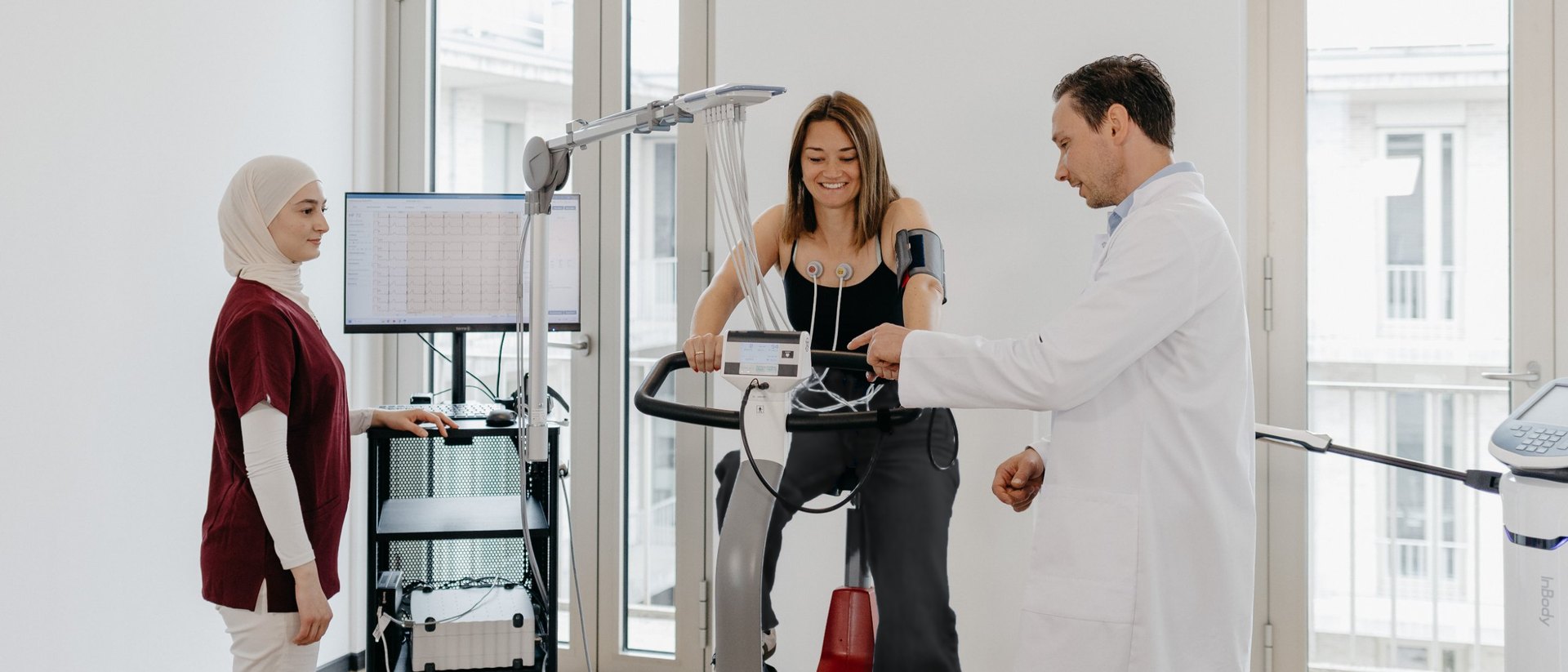
During a lactate test, we increase the workload on a cycle ergometer in fixed stages. After each stage we measure blood lactate from a single drop of capillary blood, alongside heart rate and power output in watts. From the lactate–power curve we determine your aerobic threshold (LT1) and anaerobic threshold (LT2) and derive your personal training zones.
A repeat test after a few months shows how your endurance has developed and whether your zones need adjusting.
We are here for you
Mein Ziel ist, dass Sie sich medizinisch bestens betreut und persönlich gut aufgehoben fühlen - mit einem freundlichen Team, einer angenehmen Praxisatmosphäre und dem Gefühl, dass Ihr Anliegen ernst genommen wird.

Moderne Medizin bedeutet für mich nicht nur, technisch auf dem neuesten Stand zu sein. Dazu gehört auch, mir Zeit zu nehmen, zuzuhören, alles verständlich zu erklären und gemeinsam die richtigen Entscheidungen für Ihre Gesundheit zu treffen.
Recognised certifications and partnerships with leading medical institutions reflect our commitment to the highest standards.








After COVID, flu or myocarditis, returning to training is a common reason for a sports cardiology check-up.
Myocarditis often goes unnoticed and can trigger arrhythmias during exercise. The European Society of Cardiology therefore generally recommends a break from sport of three to six months after confirmed myocarditis, followed by a cardiology review before you return.
Using ECG, echocardiography, an exercise ECG and, where needed, Holter monitoring and blood tests, we check whether your heart is ready for exercise again – and then plan a gradual return with you.
As athletes get older, the health of the coronary arteries becomes the main focus.
From around the age of 40, coronary artery disease is the most common cause of heart problems during exercise. Even very fit endurance athletes are not immune, particularly with a family history, raised cholesterol or a history of smoking.
Alongside an exercise ECG and blood tests, a coronary CT scan with calcium score can be useful. It reveals plaque long before it causes symptoms and helps us assess your risk and tailor your training.
For most heart conditions, exercise is part of the treatment. What matters is getting the dose right.
Whether you have high blood pressure, coronary artery disease after a stent, valve disease, atrial fibrillation or heart failure, there are now clear recommendations on which kind of training makes sense and how much.
We measure how your heart and blood pressure respond to exercise and give you concrete limits: heart-rate ranges for endurance training, guidance on strength training and the warning signs that mean you should stop. We also take your medication into account – beta blockers, for example, lower your heart rate.
For recreational runners it’s rarely mandatory. It makes particular sense if you’re over 35, have risk factors such as high blood pressure or raised cholesterol, have a family history of heart disease or sudden death at a young age, or notice symptoms while training.
Sports medicine doctors look after athletes as a whole, from injuries to training advice. Sports cardiology focuses on the heart: whether it is healthy enough for the training you have in mind, and whether there is a heart condition that might show itself during exercise.
It shows the point at which your body moves from easy base training into high-intensity effort. Knowing these thresholds lets you train with far more precision. Rules of thumb such as “220 minus your age” can be well off for any individual.
Regular endurance training makes the heart larger and stronger and lowers the resting heart rate. This is a normal adaptation, but some heart conditions can look similar on an ECG or ultrasound. A sports cardiology assessment helps tell the two apart.
Please bring sportswear and trainers, any previous reports and, if you like, data from your sports watch. Avoid hard training the day before and keep to a light meal on the day.
 Termin online buchenHier klicken zum Öffnen
Anrufen089 2000 51470