
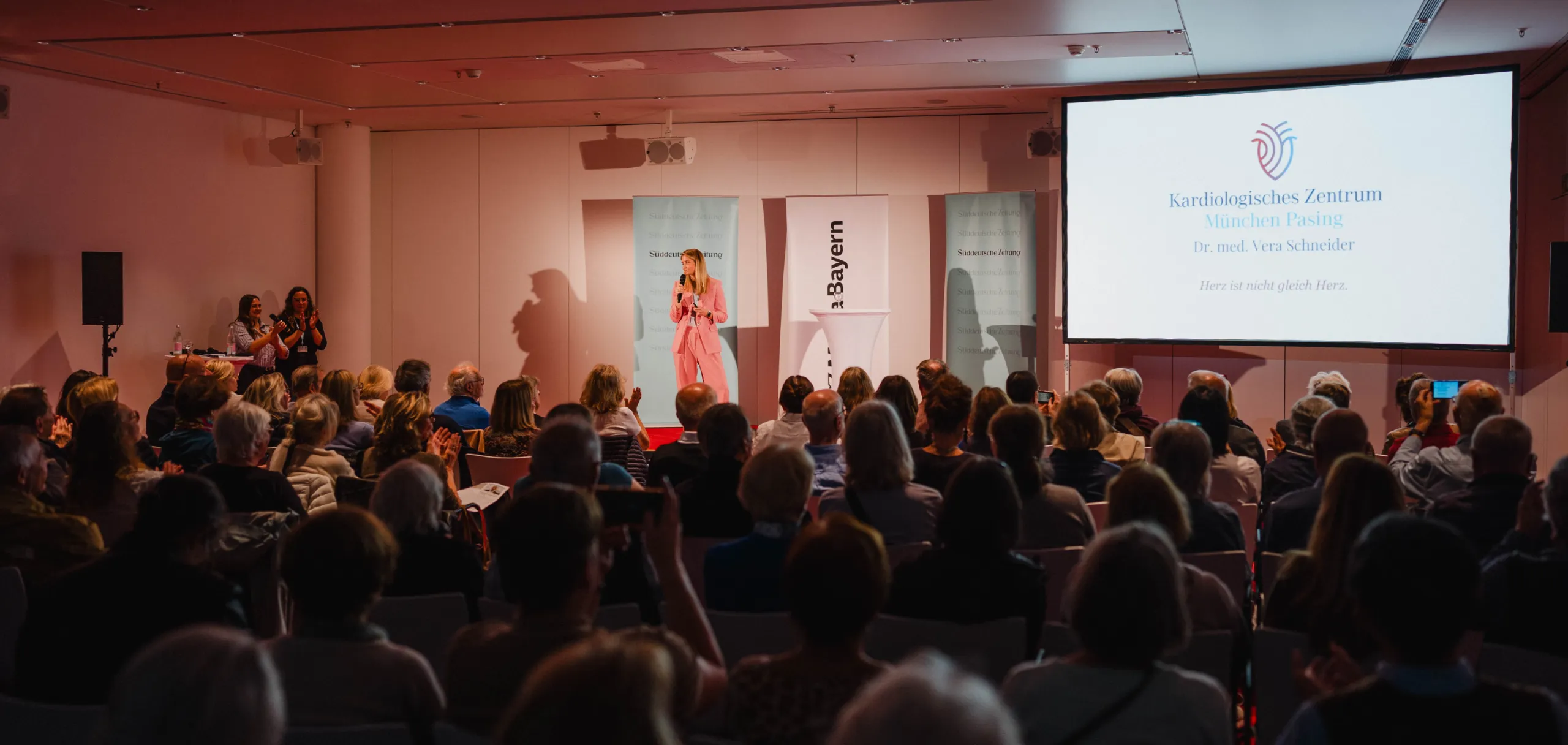
What the talk covered
On 17 October 2026, the Süddeutsche Zeitung invited the public to its Health Day (Tag der Gesundheit) at its tower in Munich. In her talk “Not all hearts are alike”, Dr. Vera Schneider, a cardiologist at our practice who specialises in women’s cardiology, explained why a woman’s heart deserves attention of its own. At our stand, visitors could have their body composition measured by bioimpedance analysis. Thank you for all the questions and conversations.
Topics:
- How pregnancy and the menopause change the heart
- Why heart problems in women are often recognised late
- What you can do for your own heart
Almost ten times as many women die of cardiovascular disease as of breast cancer.
- The figures: In Germany, around 179,000 women die of cardiovascular disease every year, compared with around 18,500 from breast cancer.
- Later, but not less often: On average, women develop heart disease later than men. After the menopause, however, they catch up, and in old age the difference has almost disappeared.
- Pregnancy: For nine months, the heart has to pump around 50% more blood, day and night. Most hearts cope well. But pre-eclampsia, high blood pressure in pregnancy or gestational diabetes are warning signs. After the birth, the values usually return to normal, yet the risk of heart disease later in life remains roughly twice as high, even decades on. Your pregnancy history is therefore also your heart history.
- Menopause: Four things happen here, quietly and often at the same time. Abdominal fat increases. Oestrogen falls, and with it its natural protection of the blood vessels. LDL cholesterol rises. And blood pressure goes up, partly because the vessels become stiffer. You cannot feel any of this, but it can be measured.
- From our practice: A 54-year-old patient told us at her first appointment: “Blood pressure? Mine has always been on the low side.” Our reading that day: 148/91 mmHg.
Why heart problems in women are often overlooked
Symptoms are dismissed as stress, women seek help later, and much of cardiology was tested mainly on men.
4 in 10 women do not feel typical chest pain during a heart attack.
- Heart attacks are often quieter: In a US analysis of more than one million heart attacks, 42% of women had no chest pain. Instead, they often had shortness of breath, nausea, cold sweats, pain in the back or abdomen and unusual tiredness, not infrequently weeks beforehand. See a doctor early if you notice such symptoms, and call 112 if sudden, severe symptoms occur.
- Women seek help later: In a study from Zurich, women having a heart attack called for help 37 minutes later than men on average. In German hospitals, 14 out of 100 women with a severe heart attack die, compared with 10 out of 100 men.
- “It’s probably just nerves”: Among people with sudden episodes of a racing heart, one in two is initially misdiagnosed, usually with panic, anxiety or stress. Women receive this misdiagnosis twice as often as men. On average, it takes around three years to reach the correct diagnosis.
- Medicine made to measure for men: Only just over a third of participants in cardiac studies are women. Yet some heart medicines work in women at lower doses, and diabetes raises cardiac risk more in women than in men.
- Symptoms: Episodes of a racing heart that came on suddenly and stopped just as suddenly. Every ECG at the doctor’s was normal, because by then the episode was already over.
- Assessment: Stress, panic attacks, the menopause. The advice: relax.
- Solution: With us, she agreed to record an ECG on her smartwatch as soon as the next episode started. It showed a typical, readily treatable heart rhythm disorder. After a minor catheter procedure, she is now free of symptoms.
Find out more about how we review smartwatch ECG recordings.
- Listening: We take time for a thorough conversation and also ask about pregnancies and the menopause.
- Targeted tests: Ultrasound of the heart and carotid arteries, an exercise test and, if needed, a cardiac CT scan.
- Assessment: From this, we build your personal risk profile, including female-specific factors.
- Ongoing care: Together, we agree on a concrete plan for prevention and treatment.
And what about men?
Dr. Vera Schneider had a message for them too: in a large analysis of 34 studies, married men had a roughly 30% lower risk of cardiovascular disease than unmarried men. So, gentlemen: listen to your partner. And if she tells you to book a heart check-up, all the more so.
- Cardiovascular disease is the number one cause of death in women. So check-ups should include the heart.
- Women’s hearts often speak more quietly. Take tiredness, shortness of breath, nausea and back pain seriously.
- Good medicine takes your sex into account. Pregnancy, menopause and hormones belong in every conversation about the heart.
Find out more about women’s cardiology.
Photos: Jens Hartmann / Süddeutsche Zeitung
